
Students
Students

John SIMONET
PhD Student
John SIMONET obtained his research Master’s degree in Cellular and Molecular Signaling from the University of Bourgogne Franche-Comté in 2019. During this period, he studied the impact of an HSP90 inhibitor on the LCK protein and its related signaling pathways in a T-ALL xenograft model, within Dr. GARRIDO’s team.
In 2021, he joined Dr. CALLANAN’s team, where he worked first as a technician and then as an assistant engineer, contributing to the study of the PRMT2 protein and its impact on inflammation in an AML model derived from the human HL-60 cell line. He gained expertise in molecular biology techniques such as RT-qPCR and Western blotting (including immunoprecipitation to verify protein-protein interactions), as well as Dot blotting. He also deepened his skills in cell culture, where he was responsible for monitoring the transfection of HL-60 cells to create PRMT2 knock-out or overexpression models.
In 2023, he joined the IMATHERA team under Dr. COLLIN, initially as a technician and currently as a research engineer. He has been trained in radiolabeling techniques for service provision, as well as flow cytometry methods to study, among other things, the impact of SPIONs on the polarization of murine and human macrophages. He is also involved in the technical support team to ensure the proper functioning of the laboratory (monitoring compliance with radioactive product handling in coordination with the platform’s radiation safety officers, and overseeing the operation of the BSL-2 cell culture lab).
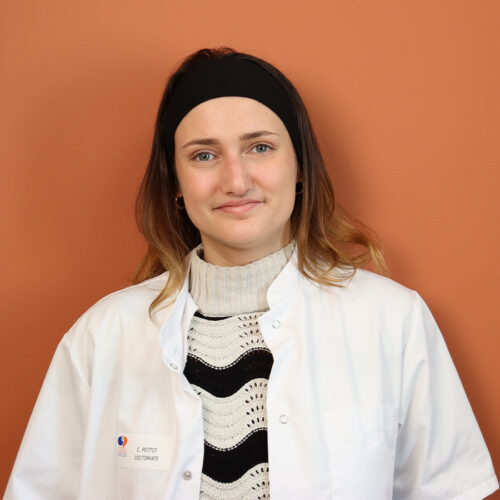
Camille PETITOT
PhD student - Radiotheranostic approaches to malignant blood disorders: impact of radionuclides on immune response and hematological toxicity
Camille PETITOT obtained her Doctor of Pharmacy (PharmD) degree from the University of Burgundy in 2023. She has been part of the IMATHERA team since 2021, with whom she has worked on several projects as an intern: Involvement of FAP as a diagnostic companion in idiopathic pulmonary fibrosis, Design and development of theranostic agents for CD38+ hematological malignancies, Improvement of imaging and therapy in HER2-low breast cancers.
Since January 2024, Camille PETITOT stared her PhD (ministerial grant – Environment-Health Doctoral School) within the IMATHERA team on the design of radiotheranostic probes for lymphomas. Her work focuses on the development of new devices for both diagnosis and therapy in the treatment of aggressive lymphomas overexpressing the CD38 protein. She is also working on optimizing the assessment of the toxicity of these therapeutic agents on blood cells, in particular using flow cytometry techniques.
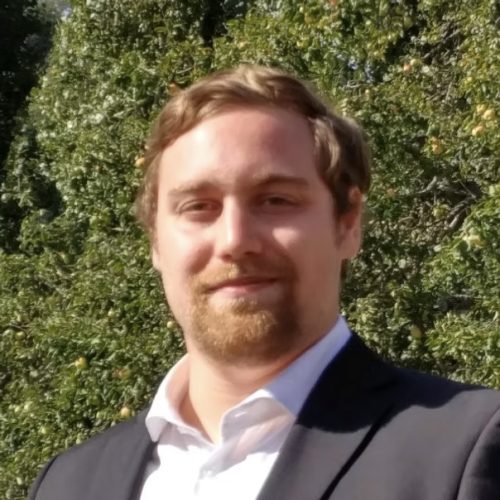
Jame FRENAY
PhD student - Imaging of CART Cells therapies
Jame Frénay graduated as a pharmacist (PharmD) from the University of Burgundy in 2021. He has been a member of the IMATHERa team since 2020, with whom he has worked on several projects as an intern and then on contract: study of a theranostic agent targeting the IL-1RAP protein in leukemia, study of a theranostic agent targeting the CD38 protein in myeloma and lymphoma, study of agents for guided surgery and photodynamic therapy.
Since January 2023, Jame Frénay has been working on a chemistry thesis (ICE grant – Itinéraire Chercheur Entrepreneur) within the IMATHERa team and the ICB laboratory (Institut Carnot de Bourgogne) on the imaging and monitoring of cell therapies (such as CAR-T cells) used in the treatment of leukemia. His work focuses on monitoring CAR-T cell therapies in solid tumor and leukemia models using medical imaging (PET/MRI and SPECT/CT). He is also working on optimizing the selection of T lymphocytes used in CAR-T therapy in order to increase its efficacy, notably via flow cytometry techniques.
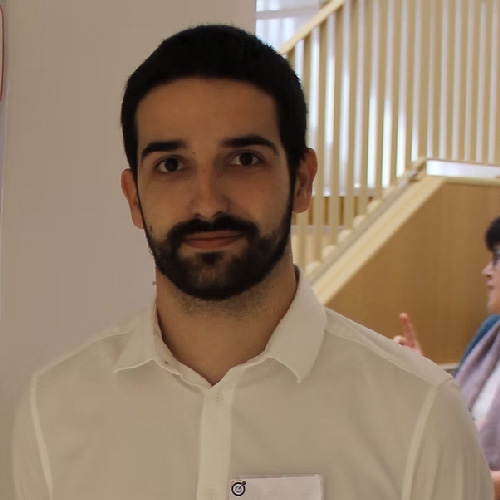
Dr Romain FONTAINE-TUFFERY
Post-doctoral Fellow

Sarah JEDIDI
PhD student - Dosimetry workflow for preclinical trials
Sarah Jedidi is a qualified medical physicist who obtained her Diploma of Qualification in Radiological and Medical Physics (DQPRM) from CEA-INSTN (Saclay, France) in 2024.
During her training, she completed several internships in medical imaging and radiotherapy at IUCT Oncopole (Toulouse) and at the Centre Georges-François Leclerc (CGFL, Dijon).
Since 2024, she has been pursuing a PhD at the Centre Georges-François Leclerc (CGFL, Dijon, France) within the IMATHERA research environment. Her work focuses on preclinical radiopharmaceutical dosimetry and the development of quantitative tools for absorbed dose estimation at organ and voxel levels, under the supervision of Jean-Marc Vrigneaud, Alan Courteau, and Pierre-Simon Bellaye.

Agnieszka KOWNACKA
PhD student - RIT in HER2-low breast cancers
Dr. Agnieszka Kownacka earned her Pharmacy degree from the University of Burgundy (UFR Sciences de Santé, 2017), specializing in Research and Industrial Pharmacy. She also completed a first-year Master’s program in Biology and Health, with academic training in cardiometabolic physiopathology and therapeutic research tools. Her journey with IMATHERA began in 2017 during a research internship, where she contributed to the development of imaging agents for heart failure with preserved ejection fraction (HFpEF). She then obtained a Master of Science (MSc) in Molecular and Cellular Signaling from the University of Burgundy in 2017. As part of this program, she completed a six-month research internship at IMATHERA, during which she studied the biological effects of high- versus low-dose-rate radiotherapy in colorectal cancer models. In 2018, she joined Oncodesign Services as a Study Director in oncology and immunology. In this role, she was responsible for designing study protocols tailored to the expectations of pharmaceutical, biotech, and start-up clients. She supervised technical staff, managed the operational aspects of studies, and oversaw data analysis and reporting to provide clear, actionable results. She later advanced to lead the Preclinical In Vivo Unit (2020–2023) and subsequently the Molecular Radiotherapy (MRT) Unit (2023–2024), where she coordinated integrated radiotherapy studies and targeted therapy projects. Since February 2024, she has been pursuing a PhD at IMATHERA, focusing on molecular imaging and radiotherapy in HER-low breast cancer as part of the ANR-funded project EITHERBC.
Adam LAOUAFA
PhD student - nuclear antibodies for RIT
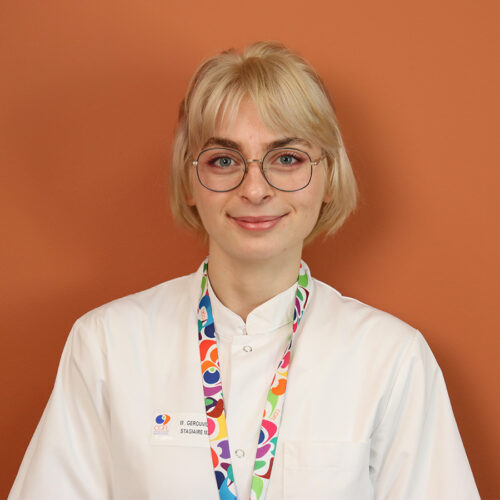
Marie GEROUVILLE
PhD student
Marie Gérouville graduated as a Doctor of Pharmacy (PharmD), with a specialization in research and industrial pharmacy from Université Bourgogne Europe in 2025. In the same year, she also completed the Innovative Drugs Master’s programme, with a focus on nuclear medicine and nanotechnology. She has been a member of the IMATHERa team since January 2025.
At the end of 2025, she began her PhD on the development of gold nanoparticles as radiotheranostic tools for pancreatic cancer, within the i-NanoT project (supported by the Région Bourgogne-Franche-Comté and the European Commission as part of the FEDER-FSE+ Bourgogne-Franche-Comté and Massif du Jura 2021-2027 program). This doctoral research builds upon her PharmD research, which investigated the impact of gold nanoparticles on neutrophil polarization in pancreatic cancer. Her PhD work broadens this scope to include the innate immune system and the fibroblastic stroma. The ultimate goal is to develop functionalized, radionuclide-labeled nanoparticles to improve the diagnosis and treatment of pancreatic cancer, which remains one of the deadliest malignancies to date.
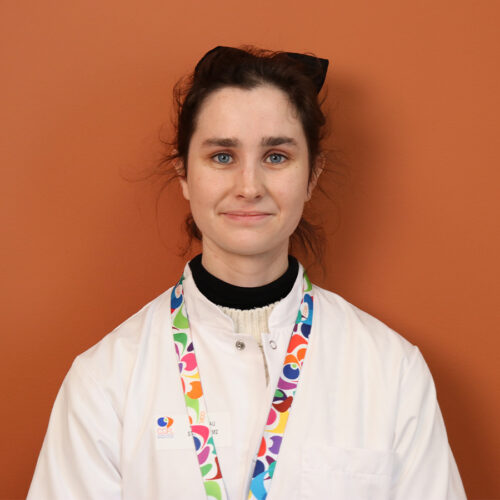
Annaëlle MOREAU
PhD Student
Annaëlle Moreau obtained her Research Master’s degree in Cellular and Molecular Signaling from Université de Bourgogne Europe in 2025. During her Master’s training, she completed three research internships within the IMATHERA team, focusing on idiopathic pulmonary fibrosis (IPF). These internships contributed to a deeper understanding of the role of heat shock proteins in regulating the expression of the pro-fibrotic receptor fibroblast activation protein (FAP) by myofibroblasts, which are key effector cells in fibrotic processes. This work led to the development of a FAP-targeted imaging agent.
To further investigate these findings, she joined our team at the end of 2025 to undertake a PhD under the supervision of Dr. Bellaye. Her doctoral project aims to develop theranostic strategies for IPF, notably through the design of targeted drug delivery (vectorization) approaches against GRP94, as well as imaging tools to monitor therapeutic responses. This PhD is conducted within the framework of the i-NanoT project (supported by the Région Bourgogne-Franche-Comté and the European Commission as part of the FEDER-FSE+ Bourgogne-Franche-Comté and Massif du Jura 2021-2027 program).